A ring is not simply jewelry. It is a compressed story, a circular archive of intention, timing, taste, and often a surprising amount of indecision. People tend to assume rings are chosen in a moment of clarity, but in reality they are usually chosen somewhere between excitement and careful second guessing. That space is where philosophy becomes useful.
At Browse 8, we treat rings not just as products but as decisions that sit at the intersection of aesthetics, psychology, practicality, and symbolism. This page explains how we think about that intersection.
The Circle Means More Than Tradition
The circular shape of a ring is often described as eternal, endless, or symbolic of unity. That interpretation is accurate, but incomplete. The circle also removes hierarchy. Unlike many objects, a ring has no clear beginning or end. This subtle design choice mirrors what most successful partnerships eventually discover: balance works better than dominance.
From a purely visual standpoint, the circle also frames the diamond. It gives the stone context. Without the ring, a diamond is a mineral specimen. With the ring, it becomes an intentional focal point.
Diamond Color Is a Conversation, Not a Number
Diamond color grades are useful, but they are not absolute experiences. A G color diamond in a platinum setting behaves differently from the same diamond in rose gold. Lighting conditions, skin tone, metal choice, and cut quality all influence how color is perceived.
This is why our philosophy emphasizes relational evaluation:
- Diamond color relative to metal tone
- Diamond color relative to clarity visibility
- Diamond color relative to real-world lighting
Perfection on paper does not always translate to visual harmony in daily wear.
Metal Choice Is Emotional Engineering
Gold color choices carry emotional undertones even when people do not consciously notice them:
Rose gold often signals warmth, intimacy, and softness.
Yellow gold suggests tradition, continuity, and optimism.
White gold or platinum tends to communicate precision, modernity, and restraint.
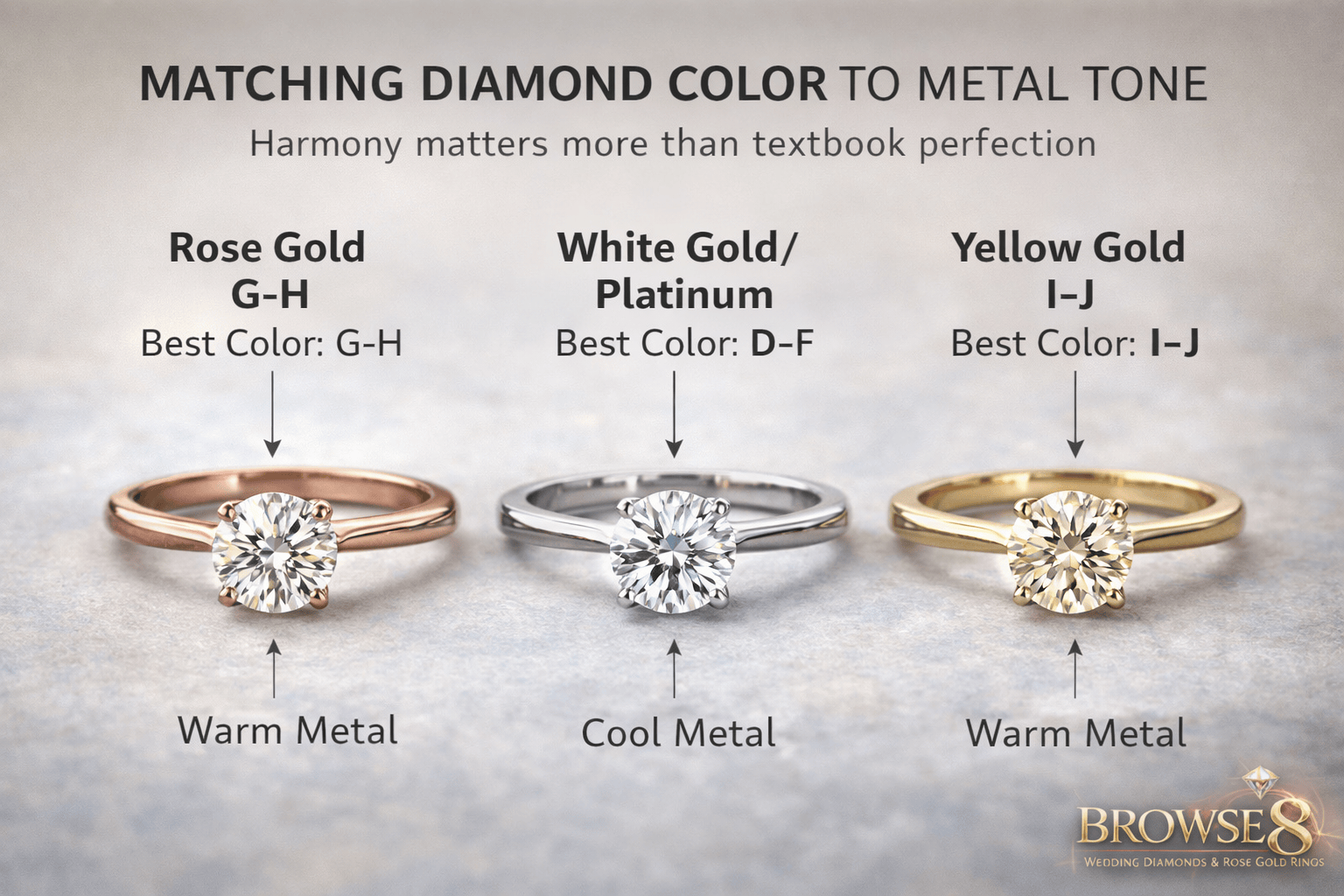
None is objectively better. Each creates a different emotional field around the diamond.
Matching diamond color to metal tone is less about rules and more about resonance. The goal is coherence, not perfection.
Wedding Rings Live in the Real World
Many ring discussions ignore practical realities:
- Hands move constantly
- Lighting changes hourly
- Surfaces are unpredictable
- Attention spans vary
A diamond that dazzles under jewelry store lighting may behave very differently in an office, kitchen, or outdoor setting.
Our philosophy prioritizes rings that:
- Look consistently good
- Require manageable maintenance
- Fit comfortably long-term
- Retain emotional appeal after novelty fades
Longevity matters more than first impressions.
The Psychology of “Enough”
One of the most interesting patterns we observe is the search for an invisible threshold. People want a diamond that feels substantial without feeling excessive. They want brilliance without ostentation, quality without anxiety.
This threshold varies widely, but it almost always exists.
Finding it requires honesty about:
- Budget comfort
- Lifestyle realities
- Personal aesthetic
- Partner expectations
Rings chosen beyond that threshold often become quietly stressful rather than joyful.
Certification Is Context, Not Destiny
Grading labs such as GIA and IGI provide valuable structure, but a certificate is not a personality. It describes measurable characteristics, not lived experience.
We encourage viewing certificates as:
- Technical maps
- Verification tools
- Starting points for evaluation
Not final verdicts.
The diamond still needs to be seen, imagined, and understood within its future context.
Imperfection Can Be Beautiful
Flawless diamonds are technically impressive, but many people find subtle inclusions or slight warmth more approachable. Perfection can sometimes feel distant. Slight individuality often feels human.
This does not mean lower quality is better. It means character sometimes outweighs laboratory symmetry in emotional impact.
Balance, again, is the recurring theme.
Wedding Rings Are Long-Term Companions
Unlike most purchases, wedding rings are not seasonal. They accompany:
- Celebrations
- Ordinary days
- Stressful periods
- Quiet moments
A good ring adapts gracefully across all of them.
Comfort, durability, and emotional stability matter as much as brilliance.
Our Guiding Principle
If a ring still feels right after:
- careful research
- realistic budgeting
- metal consideration
- color evaluation
- long-term imagining
it is probably the right ring.
Confidence rarely arrives suddenly. It accumulates.
The Browse8 Conclusion
A ring does not create a relationship, but it can reflect one beautifully. When chosen thoughtfully, it becomes less an accessory and more a quiet constant. Something small, circular, and surprisingly grounding.
That is the philosophy behind how we approach diamonds, metals, and wedding rings at Browse 8.
Not perfect rings.
Not perfect diamonds.
Just the right ones.
Resent Comments